
Where the Jaguar Dances
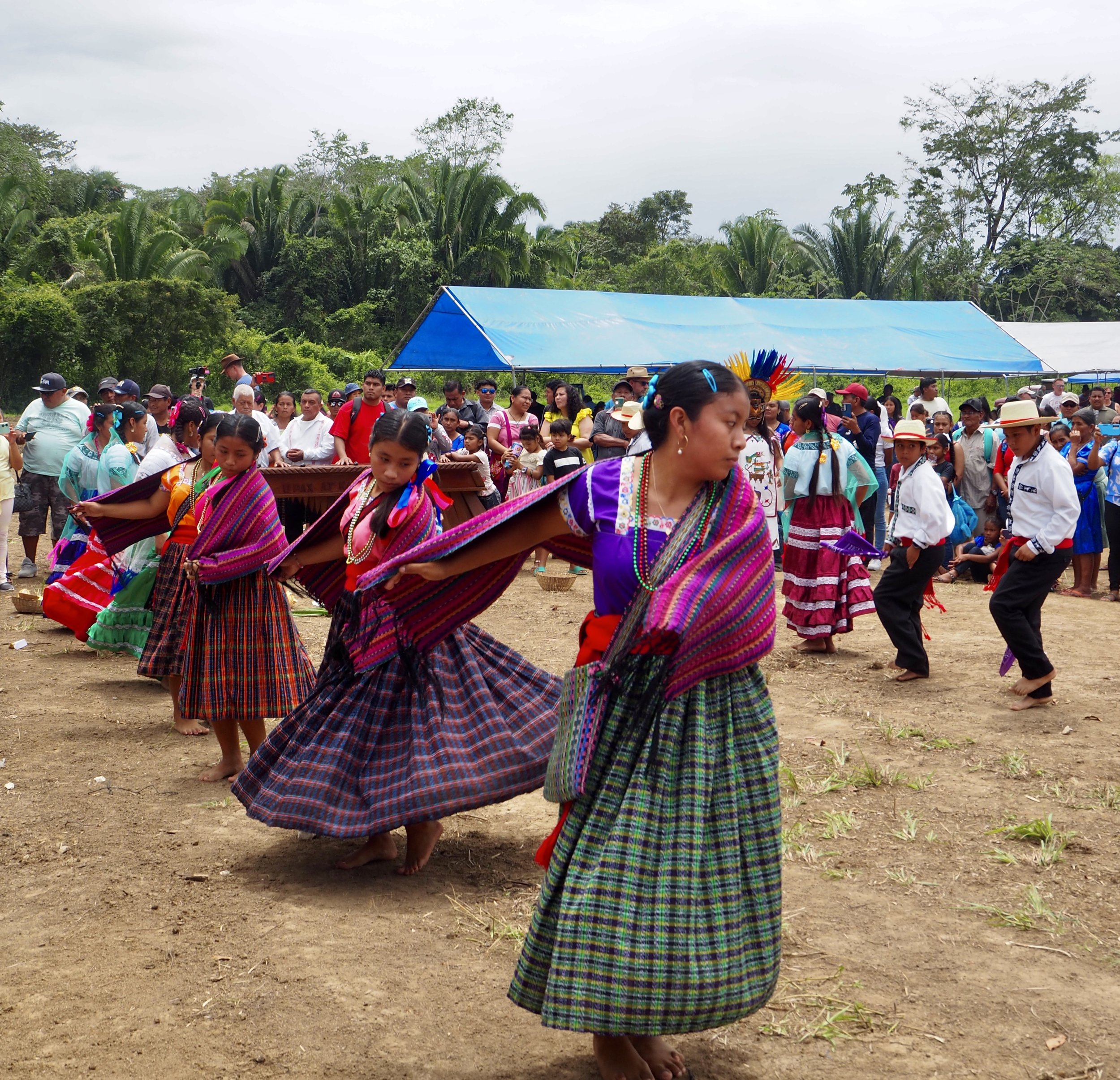
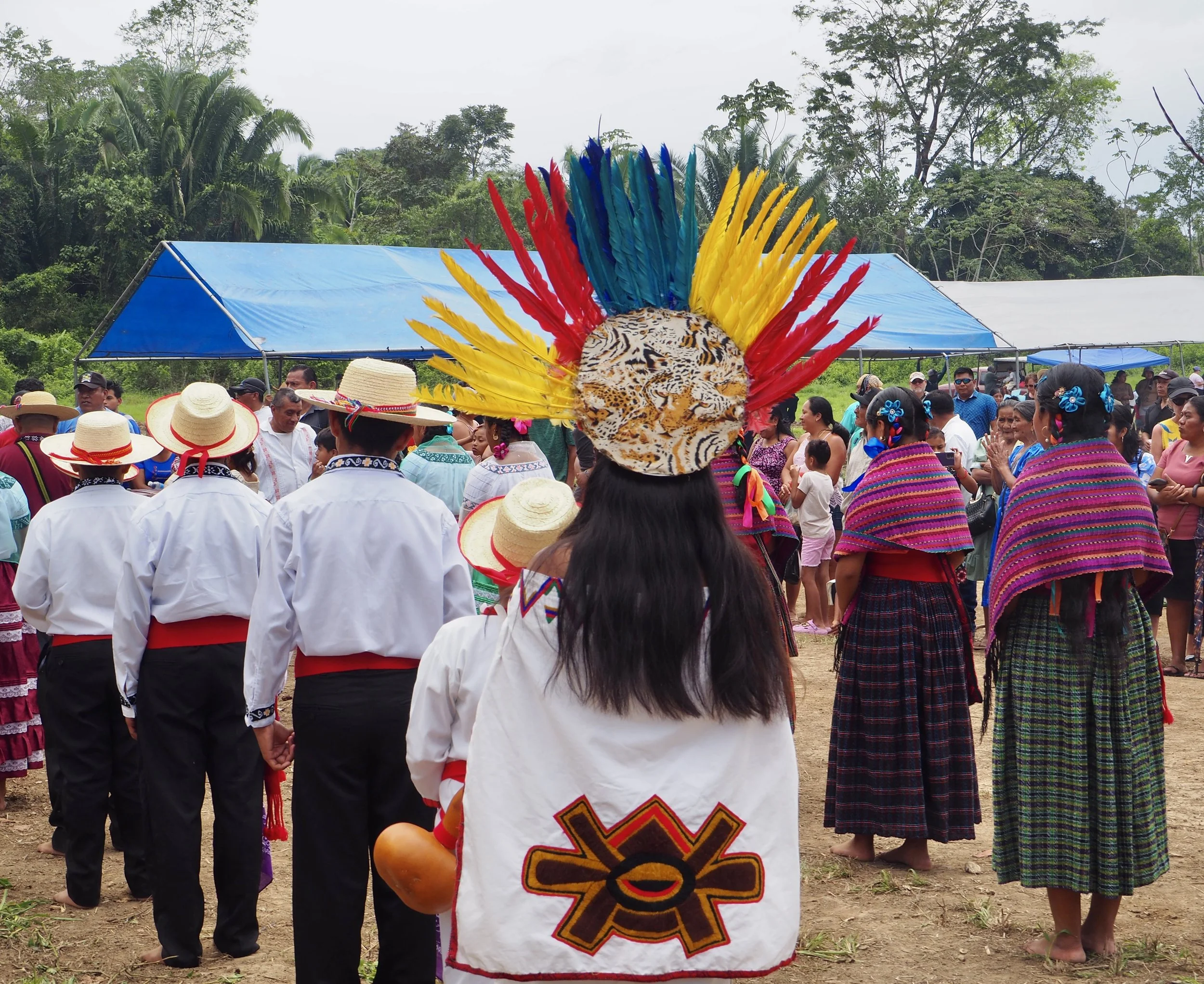
The dancers are poised in pairs, with hands clasped behind straight backs. The men are wearing black trousers and white shirts, held in place by bright red waistbands. Matching ribbons are tied around their jipis — sun hats woven from strands of dried palm. The collars and cuffs of their shirts are decorated with intricate needlework; silver threads interlaced to form ancient geometric shapes. Across from them women wear blouses which are block-coloured and bold, and cortes, wrap-around skirts which pinch their waists and flow over their hips. Knitted shawls of pinks, blues and purples sit across their shoulders, under plaits of black silk, decorated with ribbons and fabric flowers. The final pair break the sequence. Before the men stands a girl in white. Her hair falls loose across her shoulder, beneath a headdress of jaguar stripes and brightly coloured feathers. In her right hand is a bronze urn. From it rises the sweet smoke of copal incense, carrying prayers to the gods. Opposite the girl stands a boy in a one-piece jaguar suit, stoically maintaining composure as a younger child in the crowd yanks at its tail. All dancers are barefoot, connected with the land in this remote Maya village.
Like many of the best travel stories, it was a chance encounter that led me to Maya Day at Blue Creek. A ferry scheduling mishap became an extra weekend in Belize and a journey south to Toledo, the country’s southernmost district, and the cultural heartland of Belize's Maya communities.
Belize’s deep south
Disbanding my bus at the village of San Marcos, I make my way down a burnt-orange road. The dirt is baked loose and airborne, floating in lightbeams beneath the midday sun. Guided by a handpainted wooden sign, I turn onto a gravel pathway, and am greeted by the familiar guarddog chorus I’ve grown used to in Central America.
Sun Creek Lodge emerges as a series of rustic wooden cabins set amidst greenery and fruit trees. It is blissfully quiet except for birdsong and the distant growl of a howler monkey. I am greeted by property owner Marisa, who lives on the property with her husband, Thomas, and their two children. Drawn to Belize by their love for nature, Marisa and her family relocated from Germany 12 years ago and ‘never looked back.’
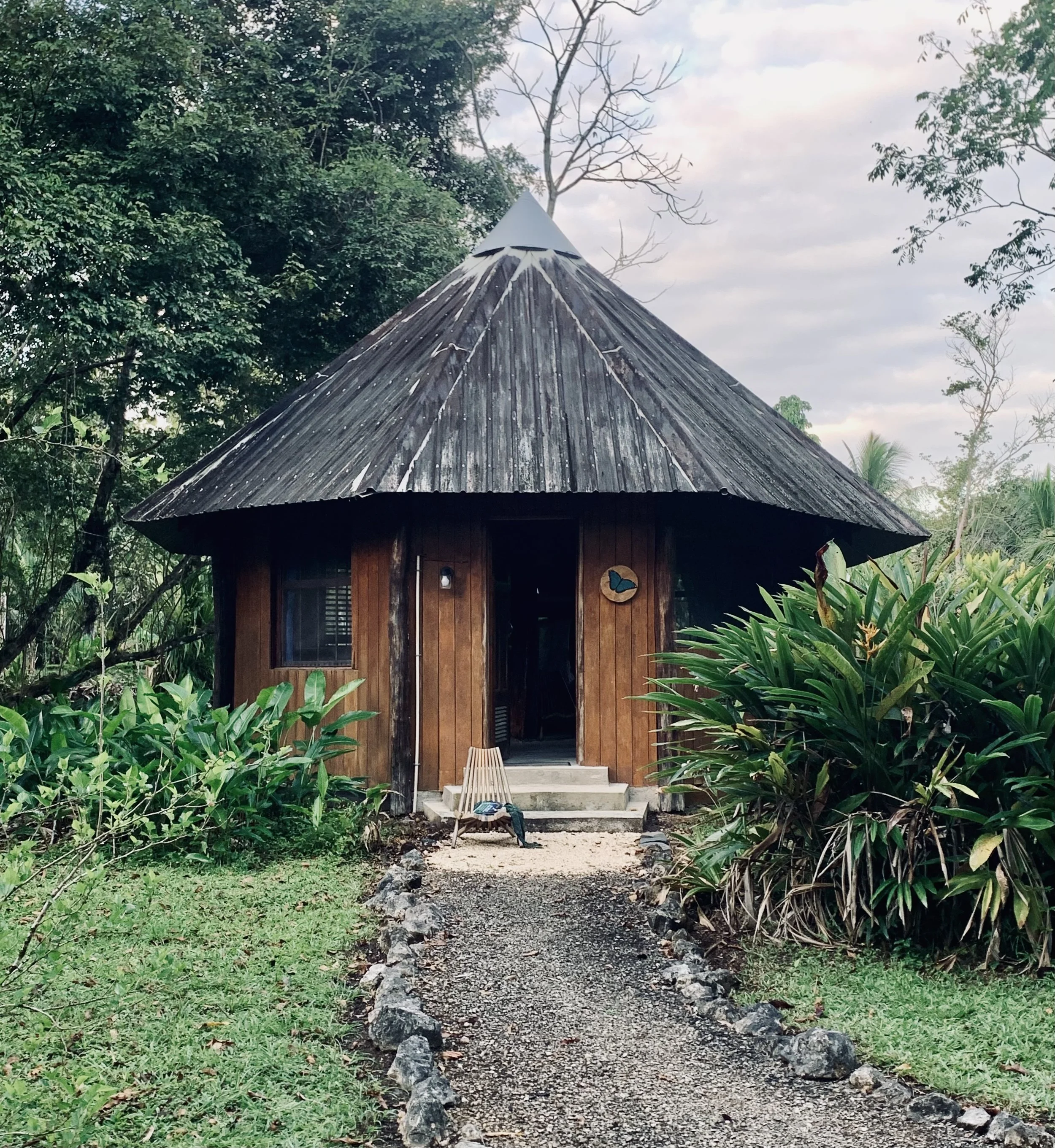
I soon meet other guests who have also found home in Toledo. Evan, a chef from North Carolina, along with his mother, Trish, and Miguel, the caretaker of Evan’s Belizean property, which is a short drive from the lodge. ‘Tomorrow we’re heading to Maya Day celebrations at Blue Creek. You could join us?’ Evan says warmly.
Maya Day — organised by the Maya NGO Tumul K'in Center of Learning — is an annual celebration of Maya culture in Blue Creek village. Though it takes place every year, the exact date varies according to the Maya calendar. The chosen date coincides with the Nawal of Prosperity, a sacred day associated with enlightenment and tranquillity. I accept Evan’s invitation without hesitation.
On our drive to Maya Day, I learn that Evan and Trish first visited Toledo together in 2002 and have returned many times since. They are here so Evan can look into selling his current property — a remote and rustic Maya house with a stream at the foot of the garden in lieu of running water — and purchase a new property with some more modern amenities. I ask Evan whether he has found any new land which has interested him yet.
‘Still looking at the moment’, he says. ‘Though things could be about to get more complicated, with new rules about land ownership.’
Evan explains that there is currently a lot of uncertainty around land rights in Belize as the government continues to work on legislation for the Maya Land Rights Bill which was approved over a decade ago in 2015. The bill says that indigenous Maya have rights to ancestral land that they collectively own and manage according to customary laws which existed before the modern Belizean state.
‘There have been a lot of delays because people can’t agree how the bill will look in practice. Indigenous Maya should have rights to their traditional land but private landowners — foreign and Belizean; Maya included — are worried they will lose their land if their homes are built on an area which is later recognised as traditional Maya land.’
We arrive at Blue Creek late morning, when Maya Day celebrations are already well underway. Parking on the outskirts of the village, we follow a line of motor scooters, open-top trucks piled high with hitchhikers, and packed-out black and yellow school buses negotiating winding gravel roads like wasps with clipped wings. People of all ages have gathered to celebrate Maya Day from teenagers in hipster jeans and basketball jerseys to elders donning colorful woven fabrics, all making their way down to the event field. Stalls and vendors fight for space around the perimeter of the field, selling everything from pottery and textiles to tortillas, tamales and tostadas, and fresh watermelon juice straight from an ice-packed cooler. Towards the centre, a semi-circle is forming around the dancers. Someone hits a button on a clunky, rather ‘retro’ sound-system and the dance begins.
We watch as dancing pairs twirl towards each other and back again, each pair folding to the back of the line for the sequence to begin again. The shaman and the jaguar walk through the aisle at the centre, waving copal incense as they go.
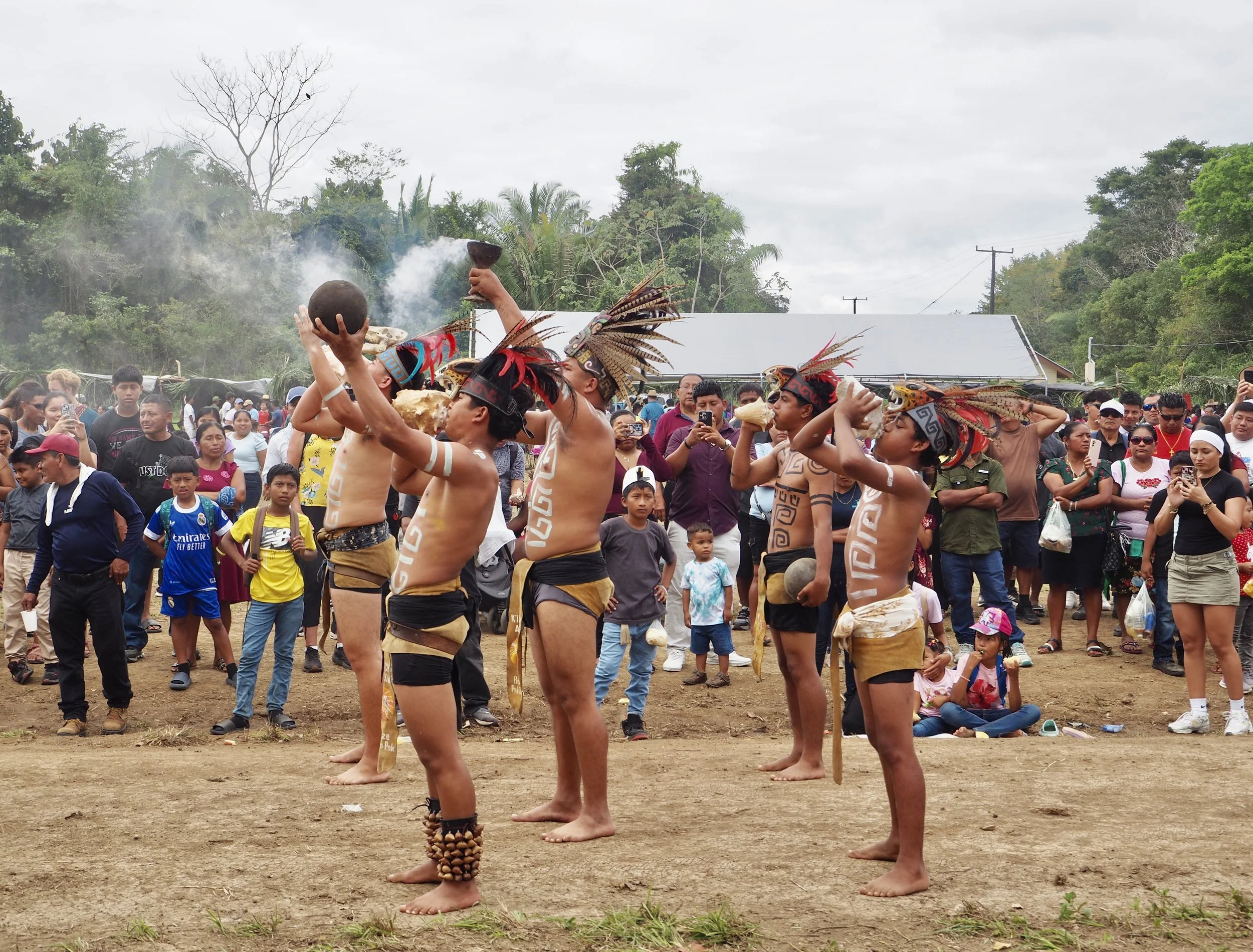
When the dance concludes, it is time for a game of pitz. With records suggesting it was played as early as 1650BC, this ancient Mesoamerican sport is one of the world’s oldest ballgames. The team keeping the tradition alive enter the pitch wearing black and tan loincloths, their torsos painted with white glyphs and feathers woven into their hair. Armed with more copal and counchells, they sound the horn to start the game. The players launch themselves at the sizeable rubber ball, using only their hips, thighs and torsos to propel it around the pitch. In ancient Maya courts, the goals were stone hoops mounted high above the court, but today the goals are more conventional. Another foregone tradition is the closing ritual. In ancient Maya it was custom for both the winning and losing team to volunteer a sacrifice to the gods once the game concluded; something considered to be a great honour. As the game is underway, I decide to take a walk around the other stands.
The land beneath paradise
At one of the stalls, I meet Elvia, who is handing out paper flyers rather than drinks and snacks. She stands behind a banner which reads SATIIM — the Sarstoon Temash Institute for Indigenous Management. Elvia explains that SATIIM is a community-based organisation which works to protect indigenous rights, safeguard ancestral lands and forests and promote sustainability through advocacy, education, and ensuring that indigenous and minority groups are fairly represented in decision-making spaces.
‘We make sure indigenous communities are educated about their rights, including their right to free, prior and informed consent and to be involved in decisions which impact their land and livelihoods.’
She continues, ‘You might have heard of the Maya Land Rights bill, which is in parliament now. We helped to campaign for it.’
Elvia tells me that concerns over indigenous land rights extend beyond private land sales to the way the government manages forests and reserves. I’m taken back to a conversation I had earlier that week, when I met Greg, a tour provider working in the Cockscomb Basin Jaguar Reserve north of Toledo. He shared that in 1984 the government had forcibly evacuated Maya villagers from the area, including himself and his family, to establish the 36,000-acre Jaguar Reserve. Despite being promised resettlement support and compensation, nothing followed.
Memory, stewardship and belonging
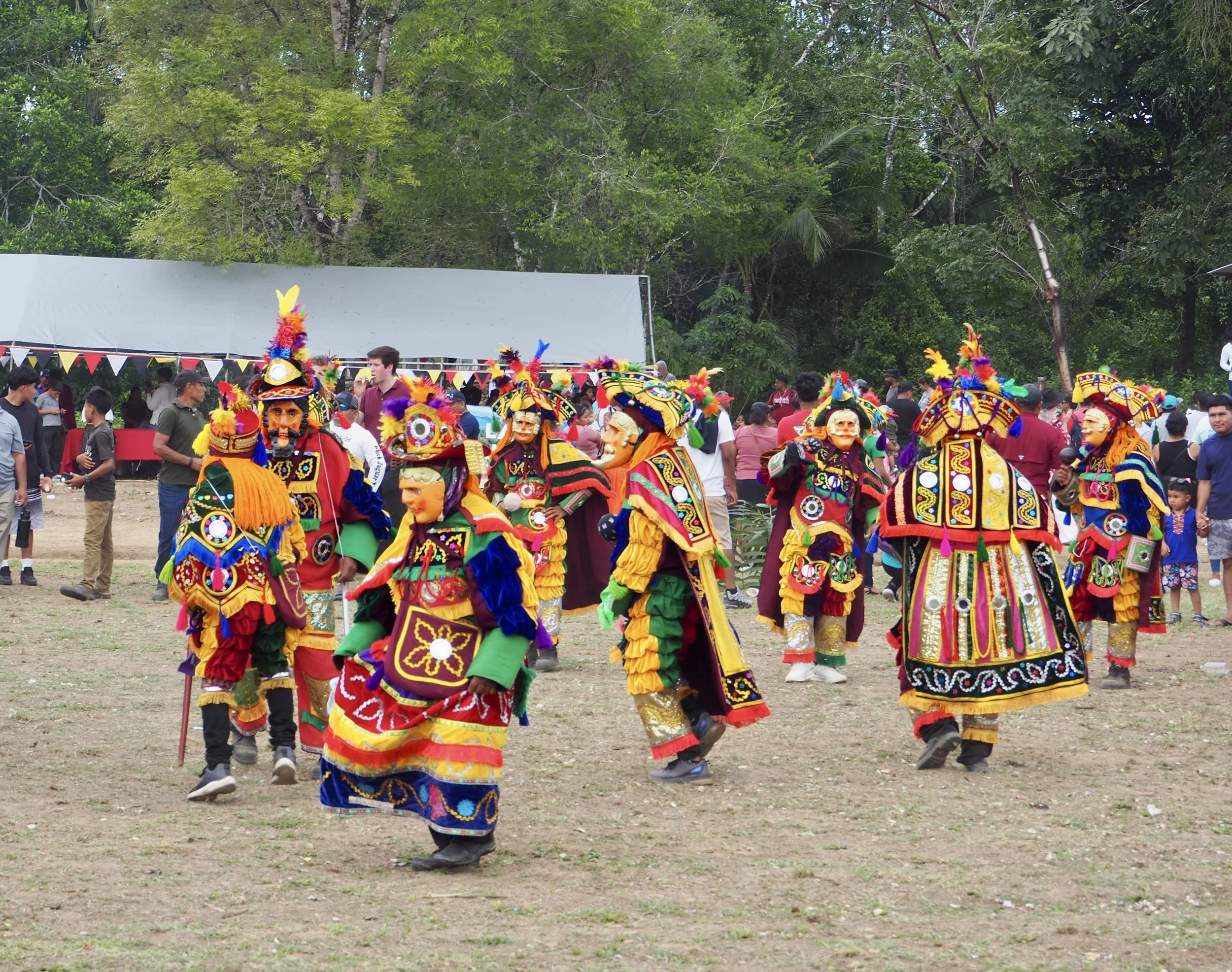
Having acquired a large plate of bean stew, plantain and purple yucca — courtesy of Miguel who kindly made sure I had enough vegetarian food to eat — we loop back to the crowd and see that another dance is about to take place. Dancers assemble in a scattered formation, wearing the most colourful costumes I have ever seen, decorated with sashes, frills and tiny hanging mirrors. Their faces are masked. Some are human faces — both Maya and others which are paler, with European features — alongside deer, dogs, jaguars and monkeys.
‘This is the deer dance.’ Miguel tells me. ‘It is the most famous Maya dance.’ The deer dance is no ordinary dance but a re-enactment of the relationship between people, animals and the land. As a marimba starts to play, the characters spring to life when one of the Spaniards spots a deer in the forest. A chase ensues, while the other dancers sway with the music, monkeys curling their arms and jaguars flexing their claws. As each animal is hunted, its dancer lays their mask upon the ground. When the forest retaliates, it is the humans who unmask. Amid ongoing conversations about land rights, the dance serves as a reminder that it is not only about property. It is about memory, stewardship and belonging. It is about home.
Katie Wilkinson is currently based in the Americas and is a guest travel writer for Travel Matters.